Use AI to summarize this article

What Really Helps with AEO for B2B Companies?
Ask a B2B founder what they did for AI visibility, and you often hear the same answer: we added schema markup, uploaded an llms.txt file, and opened robots.txt for AI crawlers. Then they wait for ChatGPT to start recommending them. It rarely happens.
Those technical steps are useful, but they are only the entry ticket. They help AI tools read your site. They don't convince AI tools that your company is the right answer. Recent research even shows that llms.txt files have no measurable effect on whether a site gets cited.
Getting recommended by ChatGPT, Perplexity, Gemini, or Claude is much harder than that. AI assistants build answers from what the whole internet says about you: your own pages, but also reviews, articles, comparisons, and discussions on other sites. To understand what really works, we first need to understand how AI search differs from the search we know.
SEO vs AEO vs GEO: what's the difference?
SEO: Search Engine Optimization
What it is: optimizing your website so its pages rank high in the list of results on Google and Bing.
The purpose: to bring visitors to your website. The user types a query, sees ten links, and clicks one. Your goal is to be the link they click.
How you get results:
- Find the keywords your buyers search for and create a page for each topic
- Optimize titles, meta descriptions, headings, and internal links
- Make the site fast, mobile-friendly, and easy for Google to crawl
- Earn backlinks from other relevant websites
What you get: organic traffic, clicks, and leads from people who land on your site. SEO usually takes months to build, but once a page ranks, it keeps bringing visitors without paying for ads.
How you measure it: rankings, organic traffic, click-through rate, and conversions from organic visits in Google Search Console and GA4.
AEO: Answer Engine Optimization
What it is: optimizing your content so it becomes the direct answer to a question, not just one of the links.
The purpose: to be the answer the user sees first. This happens in Google's AI Overviews, featured snippets, "People also ask" boxes, voice assistants, and chat-style answers. Often the user gets what they need without clicking at all, but they see your brand as the source.
How you get results:
- Structure content around real questions, with the answer in the first one or two sentences
- Use clear headings, short paragraphs, lists, and tables that are easy to extract
- Add FAQ sections and schema markup so machines understand what each part of the page answers
- Keep facts precise and current: numbers, prices, steps, and dates
What you get: visibility and authority at the exact moment of the question. Fewer clicks than classic SEO, but your brand is positioned as the expert, and the clicks you do get come from people who already trust you.
How you measure it: featured snippets and AI Overview appearances, impressions in Search Console, and branded searches over time.
GEO: Generative Engine Optimization
What it is: optimizing how your brand appears in answers written by generative AI tools like ChatGPT, Perplexity, Gemini, and Claude.
The purpose: to be mentioned, recommended, and cited when AI combines information from many sources into one answer. When a buyer asks "what's the best tool for X?", you want your company in that answer, described correctly.
How you get results:
- Publish detailed, specific content AI can quote: who you help, how, and with what results
- Build a consistent story across the whole web, not just your own site
- Earn mentions in reviews, industry articles, comparison lists, and communities
- Make sure AI crawlers can access your site, and keep content fresh
What you get: recommendations at the very start of the buying journey, often before a buyer ever visits Google. Leads from AI tools usually arrive better informed, because AI has already explained what you do.
How you measure it: how often you're mentioned for your buyers' prompts, how AI describes you, which sources it cites, and referral traffic from AI tools.
The key point: good rankings don't guarantee AI visibility. One analysis found that 28.3% of ChatGPT's most-cited pages have no Google organic visibility at all. AI search plays by partly different rules, so SEO is the foundation, but not the whole strategy. In this article we use AEO as the umbrella term for both AEO and GEO.
1. Detailed copy that answers real buyer questions
AI assistants can only recommend you for what you clearly say about yourself. If your homepage says "innovative solutions for modern teams", an AI has nothing to work with. If it says "inventory software for mid-size manufacturers that cuts stock errors by 30%", it has a fact it can repeat.
The more specific and detailed your copy is, the more questions you can be the answer to:
- Case studies with real numbers: the client's industry, the problem, what you did, and the result in numbers (time saved, revenue, conversion rate, leads per month)
- Solution pages per problem and industry: not one generic services page, but a page for each use case your buyers search for
- Comparisons with other tools: honest pages like "Your product vs Competitor" or "Best tools for X", with tables and clear pros and cons
- Pricing and process: what it costs, how long it takes, and what the steps are. Buyers ask AI these questions constantly
- FAQs in your buyers' words: the exact questions sales hears on calls, each answered in the first sentence
- Fresh content: dates, current data, and regular updates. One study found that pages not updated quarterly are 3x more likely to lose their citation status
A simple test: if a stranger read only your website, could they explain who you help, how, and with what results? If not, an AI can't either.
2. The content types AI cites most
Not all pages are equal in AI search. A Wix Studio AI Search Lab study of 75,000 AI answers and over 1 million citations found that more than half of all citations come from three content types: listicles, articles, and product pages. Listicles alone earned 21.9% of citations, articles 16.7%, and product pages 13.7%.
Comparison pages are even more interesting. They are rare, but very effective: a study of 25,337 citations found they earn 1.87 citations per AI retrieval, 45% above average, while making up only 4.1% of content.
Keep in mind that each AI tool has its own taste. The Wix study found that Perplexity takes 17% of its citations from discussions on sites like Reddit, LinkedIn, and G2, more than double other models. And only 11% of domains are cited by both ChatGPT and Perplexity. A good AEO plan covers several formats, not just one.
3. Owned media vs earned media: what AI actually reads
This is the part most companies miss. There are two kinds of content about your business:
- Owned media is everything you publish yourself: your website, blog, case studies, docs, and your own social profiles.
- Earned media is what others say about you: reviews on G2, Capterra, or Clutch, articles in industry publications, mentions in "best tools" lists, podcasts, partner directories, and discussions on Reddit or LinkedIn.
AI search leans heavily on earned media. A University of Toronto study found that AI search engines show a systematic and overwhelming bias toward earned media over brand-owned and social content, unlike Google's more balanced mix. And Ahrefs data on 75,000 brands showed that brand mentions correlate about 3x more with AI visibility than backlinks.
Why? AI tools try to give answers that can be trusted, so they look for confirmation. A claim on your own website is just you talking about yourself. The same claim in a review, an industry article, or a comparison written by someone else is proof.
This doesn't make your website less important. Owned content is still the baseline for earning visibility in AI search: it's where AI finds the facts that others confirm. The winning combination is a detailed website plus a steady flow of independent mentions that tell the same story.
For B2B companies, the most practical earned media sources are:
- Reviews on G2, Capterra, Clutch, or industry-specific platforms, from real clients
- Listings in partner and expert directories of the platforms you work with
- Guest articles, interviews, and podcast appearances in your industry
- Being included in other sites' "best tools" and comparison lists
- Genuine, helpful answers in Reddit, LinkedIn, and community discussions
4. Technical work: the foundation, not the strategy
So where do schema and llms.txt fit? Technical work makes sure AI can reach and read your content. It doesn't make that content worth citing. Think of it as the foundation of a house: necessary, but nobody buys a house for its foundation.
What's worth doing:
- Let AI crawlers in: Check robots.txt and your CDN or firewall settings. OpenAI, for example, recommends allowing OAI-SearchBot in robots.txt so your pages can appear in ChatGPT search.
- Serve content as clean HTML: Important text should be in the page itself, not hidden behind scripts, tabs, or images.
- Use clear structure: One topic per page, descriptive headings, short paragraphs, and the answer in the first sentence of each section.
- Add schema markup: Organization, Product, Article, and FAQ schema help machines understand who you are and what each page is about.
- Keep sitemaps and internal links up to date: so new and updated pages get discovered quickly.
And llms.txt? It doesn't hurt, but don't expect results from it. An SE Ranking study of 300,000 domains found citation rates didn't change based on whether a site had the file. Google's own guidance says llms.txt won't negatively or positively impact your visibility in Search.
If your whole AEO plan fits in one text file, you don't have an AEO plan yet.
How to check if your site is ready for AI agents
AI tools are no longer only reading websites. More and more, AI agents visit sites on behalf of users: they compare vendors, read docs, and soon book demos or buy. A quick way to see how ready your site is for them is Is Your Site Agent-Ready?, a free scanner from Cloudflare.
It checks your site against the emerging standards AI agents use, from robots.txt and Markdown to MCP, OAuth, and agentic commerce.
Step 1: Run the scan
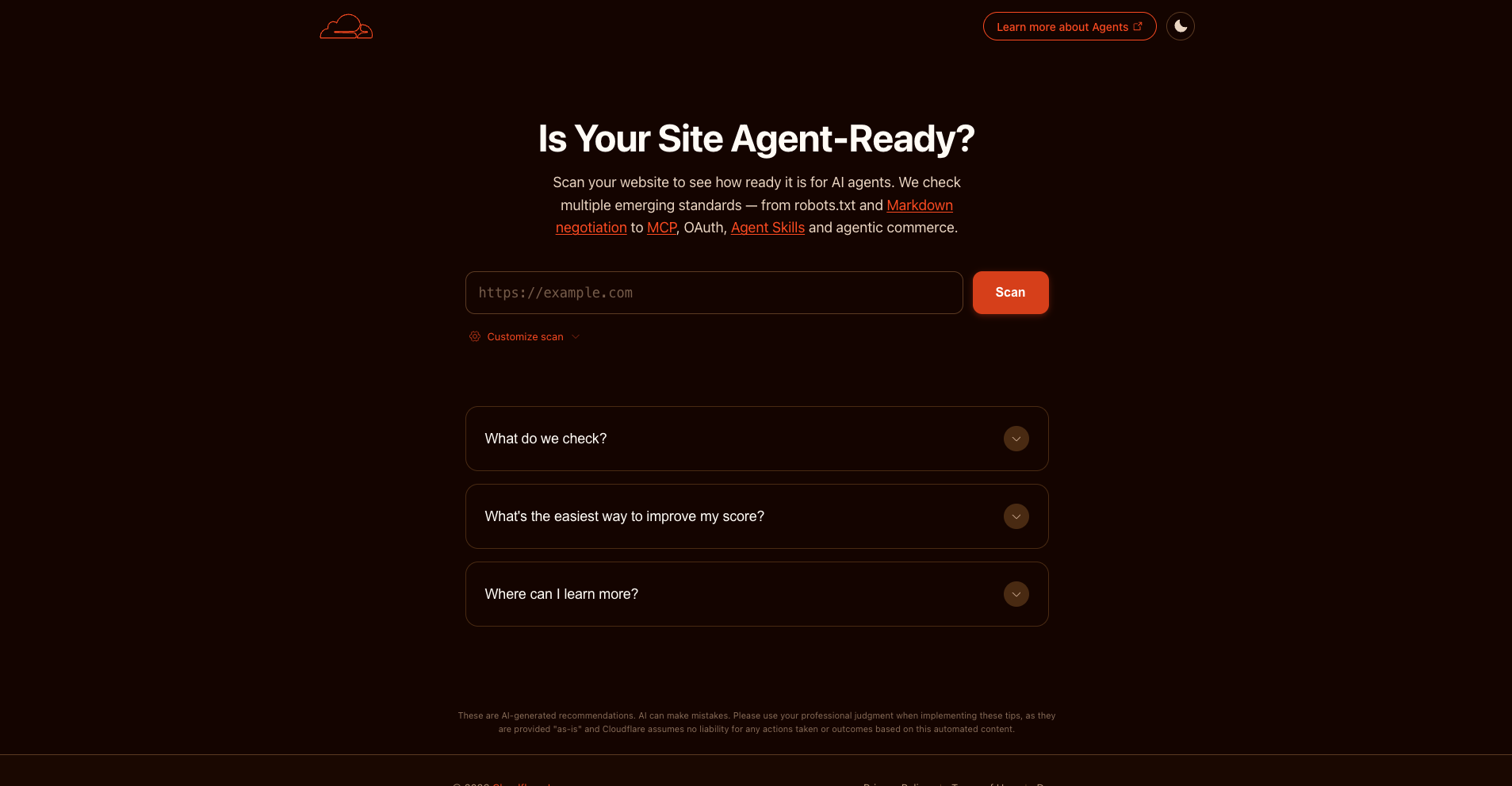
Open isitagentready.com, enter your website URL in the "Website URL" field, and click "Scan". If you only want to test certain areas, click "Customize scan" first and choose which checks to run.
Step 2: Read your results by category
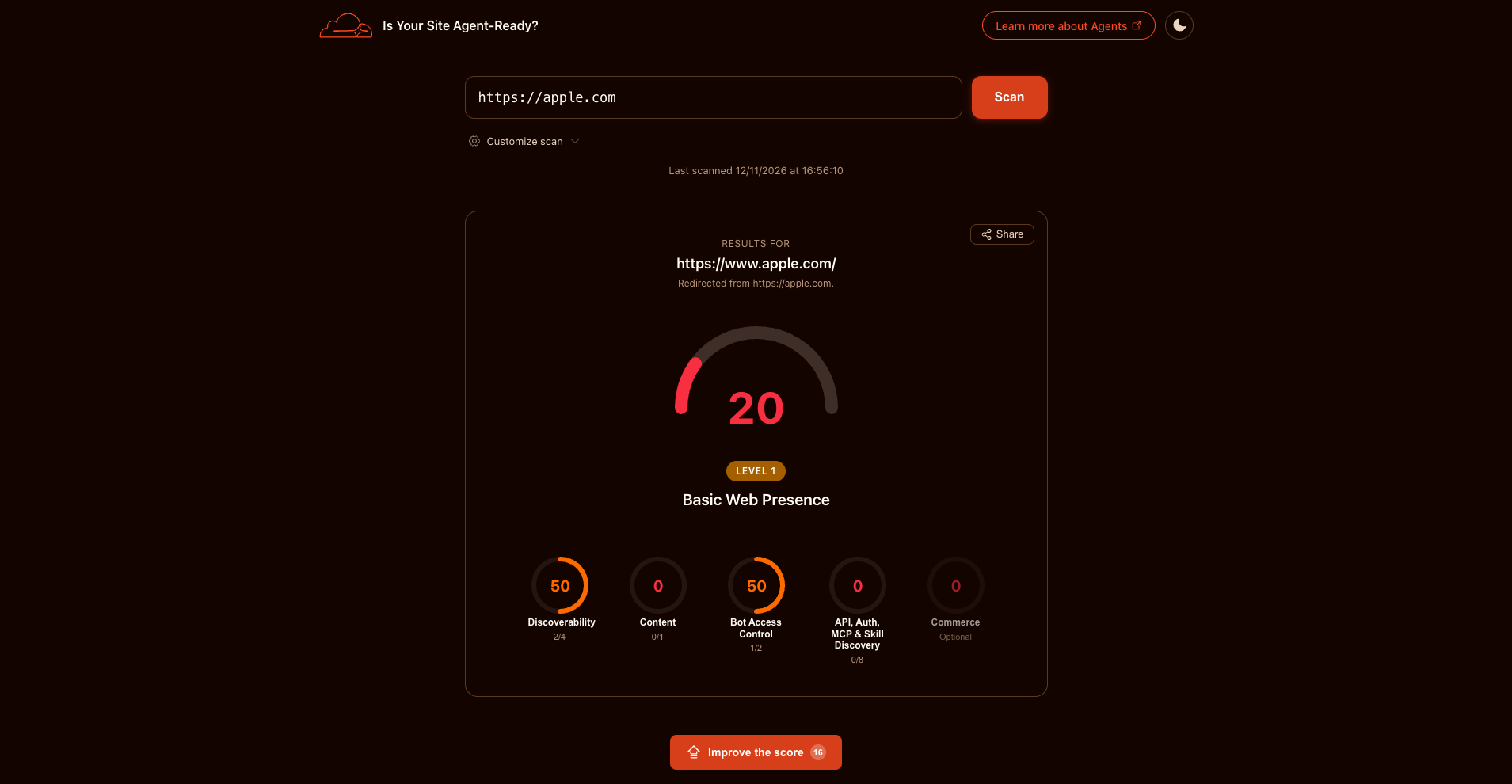
The tool runs 22 checks, grouped into five categories:
Don't panic if many checks fail. Most of these standards are brand new, and the API and commerce checks don't apply to a typical marketing website. Focus on the first three categories.
Step 3: Fix the quick wins first
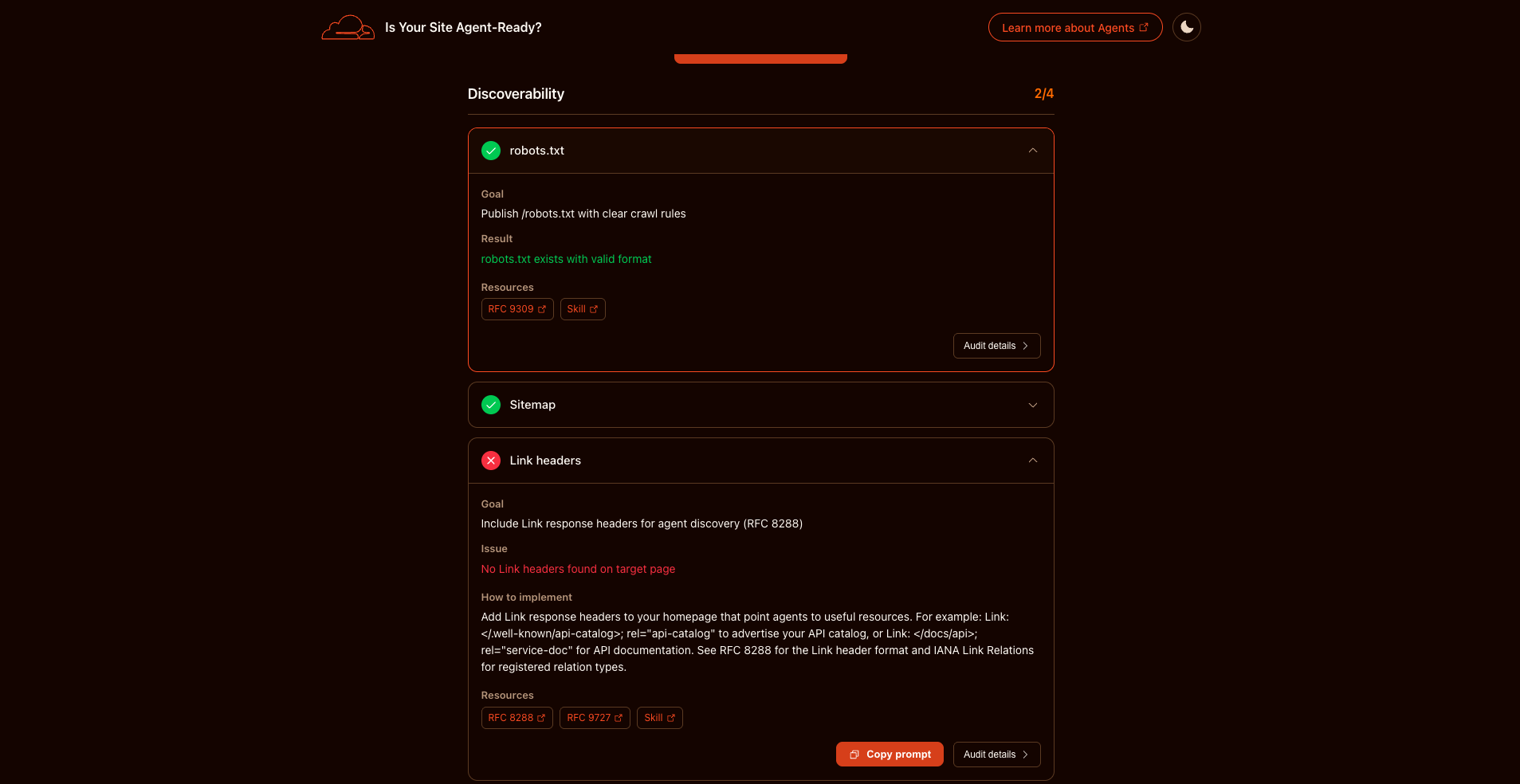
The easiest improvement is to publish a valid robots.txt with clear rules for AI bots and a link to your sitemap, and to make sure your homepage exposes useful discovery headers or metadata. On Webflow, robots.txt and the sitemap can be set in the site's SEO settings in a few minutes.
Step 4: Use the recommendations with a developer or coding agent
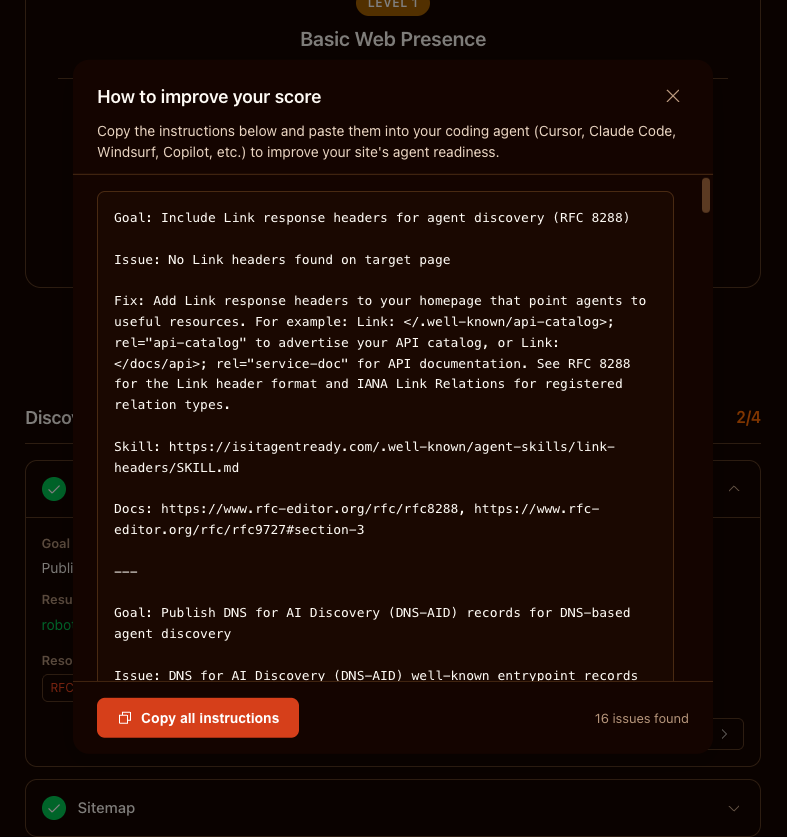
For each failed check, the tool writes AI-generated instructions on how to fix it. You can copy them one by one, or click "Copy all instructions" and paste them into a coding agent like Claude Code or Cursor. Review them before you apply anything: the tool itself notes that the recommendations may contain mistakes
Step 5: Scan again
After the changes are live, click "Scan another site" or run the scan again to confirm the fixes worked. Repeat every few months, because these standards are changing fast.
One reminder: a perfect agent-readiness score makes your site easy for AI to read and use. It still doesn't make AI recommend you. That comes from the content and earned media covered above.
Conclusion
AEO isn't a checklist you finish in an afternoon. Schema, robots.txt, and agent-readiness make your site easy for AI to read, but they don't make AI recommend you. What does is a combination of three things: detailed content that clearly says who you help and with what results, the page types AI likes to cite, and independent sources across the web that confirm your story.
SEO is still the foundation. AEO and GEO build on top of it, and they reward the same thing good B2B marketing always has: being specific, being useful, and being trusted by others. The difference is that AI tools now judge this at scale, every time a buyer asks a question.
The good news is that most B2B companies haven't started yet. Every case study, comparison page, and client review you add now makes you a stronger answer tomorrow, and that lead is hard for competitors to catch up with.
At boriswd, SEO and AEO optimization is part of every website we build. We structure pages, copy, and technical setup so both search engines and AI tools understand what our clients do, and recommend them for it.
Want to know where your site stands today? Start with a website audit, or book a 15-minute call and we'll show you how AI tools see your company right now.